
Martin County Release Dates Explained
A projected date is a current estimate produced from the sentence and the rules that apply to it. It is not the actual release transaction. Martin County’s current jail roster may display Projected_Rls_Date for a charge when that field is populated. MNDOC uses the exact label “Anticipated Release Date.” Supervised Release Board records may use “Parole Eligibility Date” or “projected release date.” Each label belongs to a different process.
A pretrial detainee may have no computable release date. Bond can be posted, a judge can change conditions, a charge can be dismissed, or another agency can maintain a hold. Even after a court orders release, jail staff must verify the order and check other holds. A sentenced person has a calculation, but the displayed date can still change. Never turn a blank field into a claim that no release is planned.
- Anticipated Release Date
- MNDOC’s public label for its current forecast of transition from prison confinement.
- Expiration Date
- The end of the sentence or department jurisdiction, not the same as release from prison.
- Parole Eligibility Date
- The earliest point a board may consider release in an eligible case, not a promise.
- Jail credit
- Time already spent in qualifying custody that a court credits toward a sentence.
Find Martin County Projected Release Dates
Start with the custody system, not with a general date calculator. Martin County Jail and MNDOC maintain different records. The court owns the sentence order. A federal or immigration matter belongs to another authority. Selecting the wrong system can produce no result or a date tied to a different stage of custody.
- Check the official Martin County Jail Roster for current local custody and its report timestamp. Read any projected field as provisional.
- Use the court case to determine whether the person is pretrial, serving a local jail sentence, or committed to MNDOC. Review sentencing and jail-credit entries.
- For a state commitment, search the MNDOC Offender Locator by a known spelling or offender ID and open the detail record.
- For a local sentence, ask the Sheriff Records Department for the sentence computation or existing release data. Do not apply a state-prison formula to the jail.
- Confirm the date with the custodian close to the event. Use notification as a prompt, not as the sole proof of release.
The Martin County released-inmate record path provides the broader method for confirming what happened after a name leaves the current roster. That step matters because disappearance can also mean transfer, state commitment, federal pickup, or correction.
Martin County Jail Date Fields
The inspected county PDF was labeled “Martin County Jail Roster Report” and “Current as of.” It showed name, age, booking date and time, arresting agency, charge, charge status, and Projected_Rls_Date per charge. Charge statuses included examples such as Pending, Bail Set, Sentenced, and Case Dismiss/NG. The report did not show an actual release date or time, release reason, booking number, or booking photo.
| Roster field | How to read it |
|---|---|
| Current as of | The point-in-time stamp for the generated current-custody report, not a promised update schedule. |
| Booking date and time | When the local booking began; it is not the sentence start in every case. |
| Charge status | The listed state of each charge, which may differ across counts. |
| Projected_Rls_Date | A provisional field tied to the report and charge; blank does not mean no release is planned. |
The county does not publish the formula behind its projected field. Local good time, court jail credit, sentence terms, and holds must be confirmed from the jail and court record. The Sheriff Records Department processes records releases during its published weekday office hours, excluding holidays. No fixed price or guaranteed response time is published for this specific record.
Note: Martin County’s roster is current-only, so an actual release time must come from the underlying sheriff custody record.
MNDOC Martin County Release Lookup
The state locator covers adults committed to the commissioner who are still under MNDOC jurisdiction. That includes people incarcerated in state facilities and people released from prison who remain under supervision. It does not cover every person booked into Martin County Jail, and it is not guaranteed to preserve a lifetime public record after final discharge.
The official MNDOC Offender Locator search screen shows the state search channel used for a prison sentence.
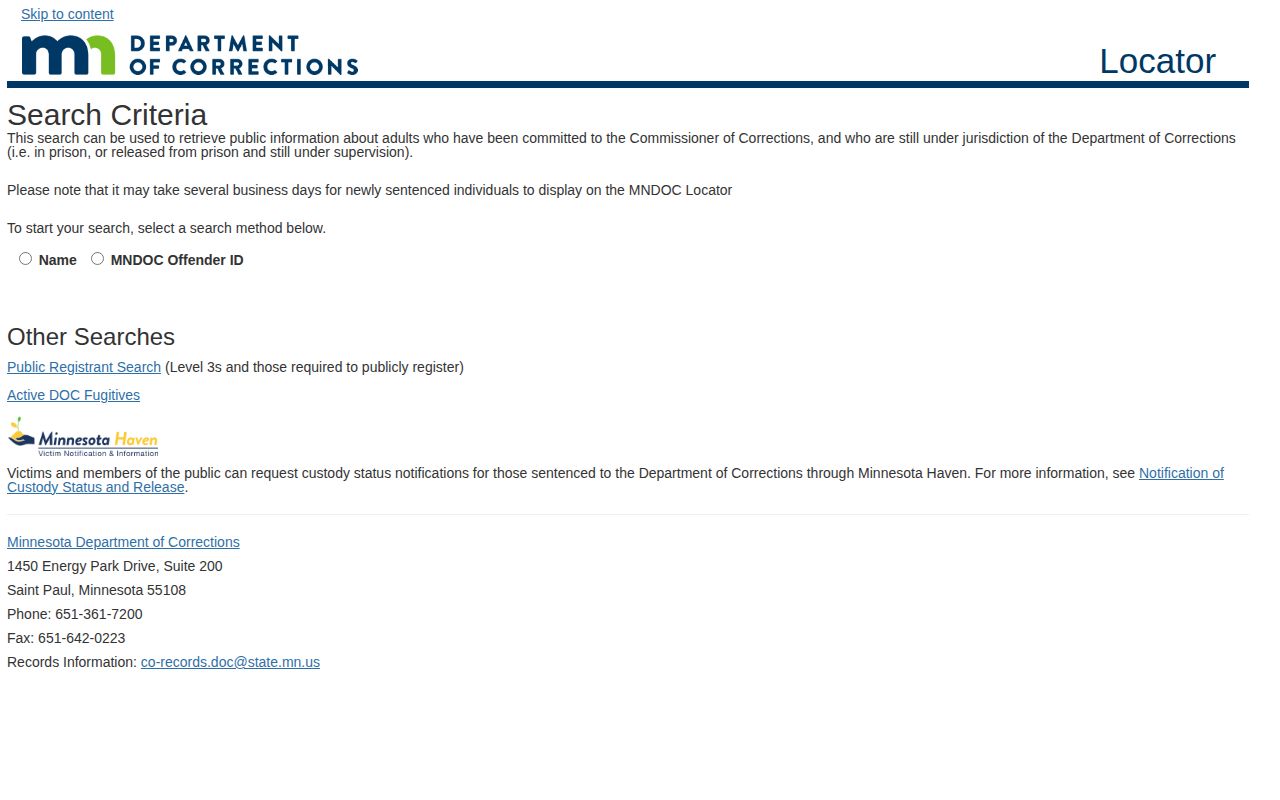
This search belongs to state corrections cases. A released county-jail detainee with no MNDOC commitment may never appear there.
Search by a known spelling and try an alias only when it is supported. An MNDOC offender ID is the strongest input. Match the detail by more than a name because similar names can produce mistaken identity. Newly sentenced people may take several business days to appear. If a result is absent, check the court commitment and ask MNDOC central records at co-records.doc@state.mn.us rather than assuming the person has been released.
Martin County MNDOC Date Labels
An MNDOC detail record can show offender ID, name, aliases, birth date, current status, sentence date, Anticipated Release Date, Expiration Date, caseworker information, highest-ranked offense, and court file number. The anticipated date forecasts transition from confinement under the present computation. Expiration generally marks the end of sentence or supervision. A person can leave prison and still remain visible as “Under Supervision as of” a stated date.
An official example MNDOC detail layout demonstrates where the status and date labels appear. The example is used only to identify interface fields and does not imply that the person shown is released.
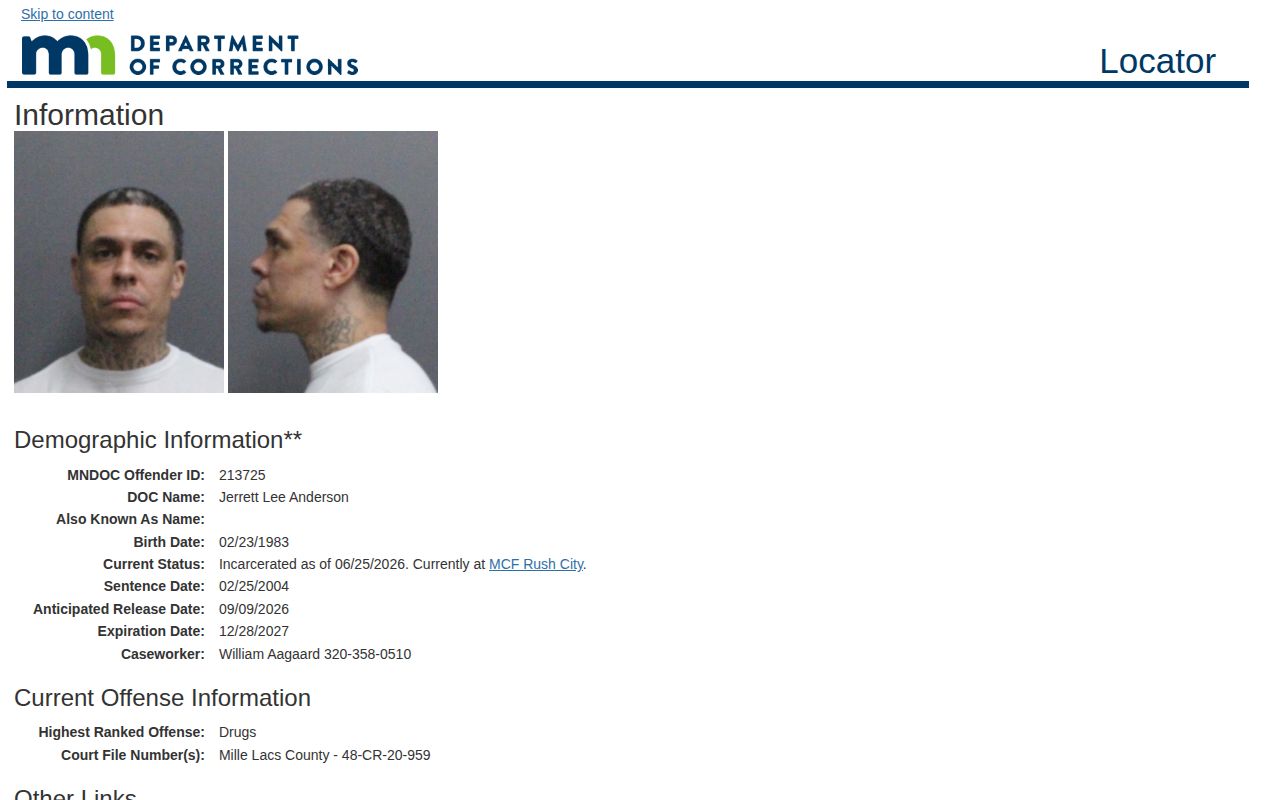
The screen’s separate labels reinforce why one date should not be substituted for another. Contact the facility or central records when the computation needs a detailed explanation.
Minnesota Release Date Framework
Minnesota does not use a general 85-percent prison rule for the ordinary covered fixed felony sentence. Under Minnesota Statutes § 244.101, covered offenses committed on or after August 1, 1993 ordinarily begin with a minimum imprisonment term of two-thirds and a maximum supervised-release term of one-third. The court must explain the total sentence, prison portion, supervision portion, and possible disciplinary extension.
A simple example illustrates the structure, not a personal forecast. A 36-month executed sentence conventionally starts as 24 months in prison and 12 months on supervised release. Jail credit, concurrent or consecutive terms, disciplinary confinement, conditional-release requirements, exclusions, and earned incentive release can alter the actual computation. The commissioner administers release under § 244.05.
Supervised release is still part of the sentence. Leaving prison does not mean discharge. A release-date lookup should therefore record both the Anticipated Release Date and the Expiration Date when each is present, then describe them accurately.
MRRA Martin County Release Credits
The Minnesota Rehabilitation and Reinvestment Act created an earned incentive framework. It should not be described as automatic “good time.” Under § 244.44, eligible people can earn incentive release credit through objectives in an individualized rehabilitation plan. The credit may subtract no more than 17 percent of the total executed sentence from the imprisonment term. It does not erase the fixed one-third supervised-release term.
Section 244.45 excludes specified groups, including life sentences, older indeterminate sentences, and people governed by the former good-time law or comparable law. Assessment, programming, achievement, safety review, and current implementation all matter. MNDOC’s MRRA information explains the state program.
Implementation is phased. A December 2025 MNDOC update placed the first phase at selected institutions beginning in February 2026, with later work continuing. Do not subtract 17 percent from a displayed date. The public Anticipated Release Date is the department’s current computation and should be read as shown.
Martin County Jail Good Time
County-jail good time is distinct from MNDOC earned incentive release. The official Martin County jail page refers to loss of good time as a possible consequence of violating visitation rules, so local good time can matter. However, the county does not publish an accrual formula on the reviewed page. No reliable release date can be computed from that reference alone.
Ask the jail for the policy and current sentence computation. Compare it with the court’s jail-credit entry. Jail credit counts qualifying time already served, while good time concerns a sentence reduction under the applicable jail rule. They are not the same. A local sentence also must not be divided automatically into the two-thirds and one-third structure used for covered state felony sentences.
Why Martin County Release Dates Change
A projected date changes when the facts or governing calculation change. Some changes move the expected date earlier. Others delay release or shift the person to another custodian. The source record should identify the factor before anyone tries to recalculate a date.
| Factor | Possible effect | Record to check |
|---|---|---|
| Jail or prior custody credit | Changes credited time already served. | Court sentencing order and custodian computation. |
| Concurrent or consecutive sentences | Changes how multiple terms overlap or follow one another. | Judgment, warrant of commitment, and MNDOC record. |
| Disciplinary confinement | Can extend prison time and reduce time left on supervised release. | MNDOC sentence calculation. |
| MRRA earned incentive credit | May advance transition for an eligible participant after approved achievement. | MNDOC Anticipated Release Date and MRRA record. |
| Detainer or other hold | May prevent community release or cause transfer to another authority. | Custodian release record and receiving-agency entry. |
| Court amendment or appeal | Can alter the sentence, credit, or authority for custody. | Court register and amended order. |
A release violation can also return a person to confinement and create a new projected confinement release date. Conditional-release terms may extend beyond the ordinary structure for designated offenses. Read the exact record label instead of compressing every change into “parole.”
Note: A detainer can end Martin County custody through transfer while preventing release to the community.
Minnesota Board and Weekend Dates
For a life or other board-controlled case, a parole eligibility date only opens the review process. The Supervised Release Board may set a projected release date or continue the case with directives. No review can authorize release before the statutory minimum eligibility date. The Board’s schedule shows upcoming review activity, while approved minutes are the result source. A hearing date alone does not prove release.
Minnesota also has a specific weekend and holiday rule for MNDOC supervised release. For post-August 1, 1992 cases governed by § 244.05, subdivision 1a, a release scheduled for Friday, Saturday, Sunday, or a legal holiday begins on the first following day that is not Friday, a weekend, or a holiday. Older covered cases use a prior eligible-day rule.
This rule is narrow. It applies to MNDOC supervised release under that statute. It should not be generalized to a Martin County bond release, a judge’s pretrial order, or every local jail sentence. Ask the relevant custodian how an actual date will be processed.
Confirm Martin County Release Timing
Close to the projected event, confirm with the office that controls custody. For Martin County Jail, call the jail information line and request the existing release record when the event has occurred. For a state prisoner, recheck the MNDOC detail and contact the facility or central records for an explanation. Minnesota VINE can send a custody-change alert, but the county jail page warns users not to depend on VINE alone.
The Martin County VINE inmate check explains how state and county notifications differ. An alert is useful for timing. The custodian’s actual release entry remains the stronger record. If the person transferred, ask for the receiving agency or destination and continue with that custodian rather than describing the event as community release.
Keep a copy of the source and note when it was checked. Dynamic dates can change. The best final statement is precise: which agency displayed which field, on what date, and whether the actual release transaction was later confirmed.